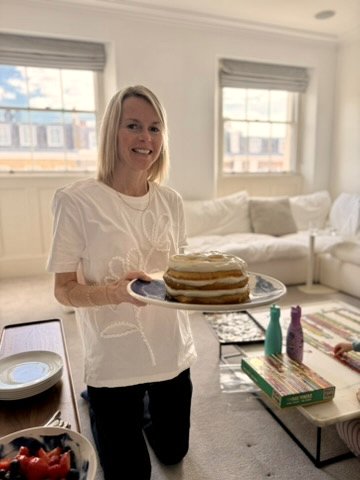
Lemon curd cake
Ingredients
Sponge
- 4 large eggs, separated
- 75g caster sugar, divided:
- 25g for yolks
- 50g for whites
- 70g Doves Farm Freee Plain Flour
- 20g cornflour
- 1 tsp baking powder
- 1/4 tsp fine salt
- 30g unsalted butter, melted
- 2 tbsp hot water
- 1 tbsp lemon juice
- finely grated zest of 2 lemons
- 1/2 tsp vanilla extract
- 1/4 tsp cream of tartar, optional but helpful
Lemon soak
- 2 tbsp lemon juice
- 1 tbsp caster sugar
- 1 tbsp hot water
Filling
- lemon curd — shop-bought, or use the reduced-sugar homemade version below*
- softly whipped cream
Homemade lemon curd (optional, reduced-sugar)
Pairs better with the low-sugar sponge than shop-bought. Sharper, less cloying.
- 2 large eggs
- 2 large egg yolks
- 80g caster sugar (or 100–120g for a sweeter version)
- 90g fresh lemon juice
- 1 tbsp lemon zest
- 60g unsalted butter, cubed
- pinch of salt
Method
1. Prep
- Heat oven to 170C fan.
Grease and line 2 x 7-inch tins.
- Melt the butter and leave it to cool until just lukewarm, not hot.
2. Mix dry ingredients
- Sift together:
- Doves Farm Freee Plain Flour
- cornflour
- baking powder
- salt
- Set aside.
3. Make the yolk mixture
- Whisk the egg yolks with 25g sugar for 2–3 minutes until lighter and slightly thickened.
- Whisk in:
- lemon zest
- lemon juice
- vanilla
- hot water
4. Whisk the whites
- In a clean bowl, whisk the egg whites with the cream of tartar until foamy.
- Gradually add the remaining 50g sugar and whisk until you have medium-stiff peaks.
Do not overwhisk to very dry stiff peaks.
5. Combine
- Fold the dry ingredients into the yolk mixture.
- It will feel fairly thick.
- Now fold in the egg whites in 3 additions:
- first addition to loosen
- second and third very gently, keeping as much air as possible
6. Add the butter properly
- Take about 3 tablespoons of batter and mix it into the melted butter first.
- Then fold that butter mixture gently back into the main batter.
- This step matters — it helps the butter blend in without sinking and knocking out all the air.
7. Bake
- Divide between the 2 tins and bake for about 16–19 minutes.
- They are ready when:
- the tops spring back lightly
- the surface is pale gold
- a skewer comes out clean
- Do not overbake.
8. Cool
- Leave in tins for about 5 minutes, then turn out onto a rack.
9. Make the soak
- Mix:
- 2 tbsp lemon juice
- 1 tbsp caster sugar
- 1 tbsp hot water
- Brush lightly over the cakes while just warm or once cooled.
Use a light hand — enough to add lemoniness, not enough to saturate.
10. Make the homemade lemon curd (optional)
- Add the eggs, egg yolks, sugar, lemon juice, lemon zest and salt to a heatproof bowl. Whisk until fully combined.
- Place the bowl over a pan of gently simmering water — bottom of the bowl should not touch the water.
- Stir constantly with a spatula or whisk for 8–12 minutes, until the curd thickens enough to coat the back of a spoon.
- Remove from heat. Add the butter a few cubes at a time, stirring until fully melted and smooth.
- Strain through a sieve for a smoother curd (optional).
- Pour into a clean jar or bowl. Cover the surface directly with cling film to stop a skin forming.
- Chill until fully cold and thickened before using.
11. Fill
- When completely cold:
- spread a thin layer of lemon curd
- add softly whipped cream
- sandwich together
- Top with more cream if you like, and either:
- a little extra curd swirled through
- lemon zest
- a very light icing sugar dusting
Notes
- Homemade vs shop-bought curd: the homemade version (80g sugar) is sharper and lower-sugar — best match for the low-sugar sponge. Shop-bought is fine for speed but will read sweeter overall. For a more traditional sweetness in the homemade curd, increase sugar to 100–120g.
- Why 75g sugar works
- Because you are:
- separating the eggs
- using a little butter only
- relying on curd for sweetness later
- So the sponge itself does not need to be very sweet.
- If you want to go even lower
- You could try 70g, but that is the point where I’d expect more risk of:
- less volume
- more fragility
- drier texture
- So 75g is my lowest sensible recommendation.
- Best filling balance
- Because the sponge is low sugar, I'd keep:
- the lemon curd layer fairly thin
- the cream only lightly sweetened, or not sweetened at all
- That will keep the whole cake fresh and sharp rather than cloying.
How this works (the science)
A lemon sponge built around fillings rather than batter sweetness — the cake structure is engineered to be ultralight so the curd and cream do the flavour work. Low sugar, low fat, gluten-free.
- Gluten replaced by Doves Farm Freee plain flour + cornflour (70g + 20g). Same low-protein blend as the genoise. The cornflour deliberately weakens the structure so the cake stays soft, not chewy. GF flour without the cornflour cut would over-set and go cardboardy.
- Sugar at 75g (split 25g yolks / 50g whites) is the absolute sensible minimum. The split is critical: most of the sugar goes into the whites because that's where it's doing the structural work (stabilising the foam). Yolks just need enough to thicken slightly when whisked. Drop below 75g total and you lose volume + crumb integrity.
- Egg whites whisked to medium-stiff peaks (not full stiff) — full stiff peaks crack and break during folding. Medium-stiff folds smoothly into the heavier yolk-flour mixture and holds air through the bake.
- Cream of tartar (¼ tsp) is optional but stabilising. Same role as in the genoise — lowers the white's pH so the foam holds at the lower sugar level.
- Only 30g butter keeps fat low. The melted butter is folded in at the end via the "butter sandwich" technique (3 tbsp batter into the butter first, then back into the main bowl). This prevents the butter sinking and knocking out air — the most common reason low-sugar low-fat sponges turn into pancakes.
- Hot water (2 tbsp) into yolks thins them so they fold into whites without deflating, and helps activate the cornflour.
- Lemon zest carries flavour without sugar. Zest contains the lemon oils (limonene, citral) — aromatic and intense without the acidity of juice. Two lemons' worth of zest in 75g of sugar means flavour-per-gram-of-sugar is high.
- Lemon soak (2 tbsp juice + 1 tbsp sugar + 1 tbsp hot water) brushed on the warm sponge adds moisture and lemon brightness without bulk. Total added sugar is just 1 tbsp across 2 layers.
- Reduced-sugar homemade curd (80g sugar) is the keystone. Shop-bought lemon curd is typically 50%+ sugar; the homemade version drops to ~40% by relying on extra yolks for body and a higher juice ratio for sharpness. Pairs better with the low-sugar sponge — shop-bought would taste cloying.
- Lightly sweetened cream layer balances texture, not sweetness. Cream's fat coats the tongue and softens the curd's sharp edge. Sweetening it is optional — most palates read the contrast as balanced even with unsweetened cream.
Variations